We’re a training company, so it’s important for us to know how people learn, and to shape our training programmes accordingly.
You’re (probably) a Recruiter, either agency, inhouse or fractional and you (probably) want to discover how to fill jobs more effectively. So it’s important for you to understand how people learn, and to choose your training company accordingly.
Our approach
The following quote is accredited to Confucius, Native Americans & the Ancient Greeks (among others):
“I see and I forget. I hear and I remember. I do and I understand.”
That’s why we include a mixture of theory and practical in our training materials.
Words on paper or on screen aren’t always enough. Even explaining things verbally, face-to-face, won’t do the trick every time.
Sometimes, the best way to get your message across is through an activity that the person being trained undertakes. It’s the “I do and I understand” part of the Confucius quote.
The theory behind our approach
The ‘Cone of Learning’ evolved from research by Edgar Gale in the 1960s, as shown in the graphic. The model is also claimed by the National Training Laboratory and is sometimes called the ‘Cone of Experience’ or ‘Pyramid of Learning’. It led to a theory of experiential learning, sometimes called ‘Action Learning’.
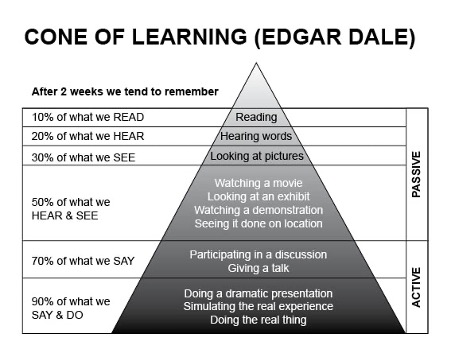
Common sense tells you that the order of activities might be about right, but the specific percentages are rather too convenient to be true. In fact, Dale didn’t include any numbers on his original continuum.
Today, it’s known that memory and recall are dependent on many other variants as well as the style of learning.
However, good trainers have always known that less is more. The less lecturing you do, and the more you make the participants do, they more they learn.
That’s why our training is blended
Step 1: Trainees start with our pre-recorded online course. In it, there’s a mix of written word and video, together with interactive self-assessment exercises and a little ‘gamification’.
Step 2: Because most learning happens when you put the theory into practice, trainees can follow the online course with a written assignment where they write a real job ad using as much of what they’ve learnt so far as possible.
They’ll then get personalised 121 feedback so they can discover what they’ve done well, what could be improved and how it might be improved. All of it is contextualised around their level of experience, current job and natural writing style.
Step 3: Groups can then book a live half-day workshop with our trainers (on-site or online), to help apply the learning to their day job in a real-world setting and have another go at improving their job ads.
“There’s a relationship between theory and practical. Practice is critical if the theory is going to work.”
But our training doesn’t end there
Step 4: We also provide a PDF ‘Book of the Course’ which trainees can keep and use for future reference.
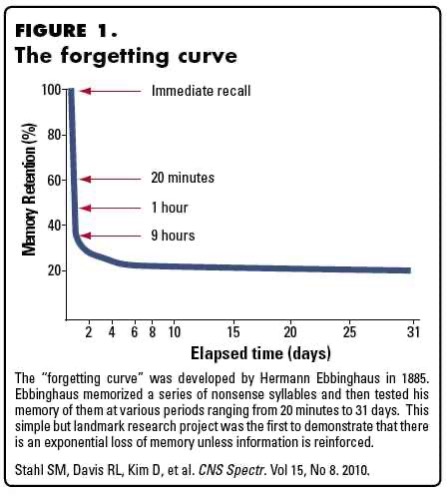
Step 5: It’s known that people forget over time. As the graph shows, “there is an exponential loss of memory unless information is reinforced”.
So we send our trainees an email every month for the next year that contains extra information, insights and useful links about recruitment marketing – at no extra charge.
These supplementary lessons build on the course content and support recruiters to put what they’ve learned into practice.
We put in this extra effort because we know, both from our own experiences and those that have done our training, that writing job ads this way works.